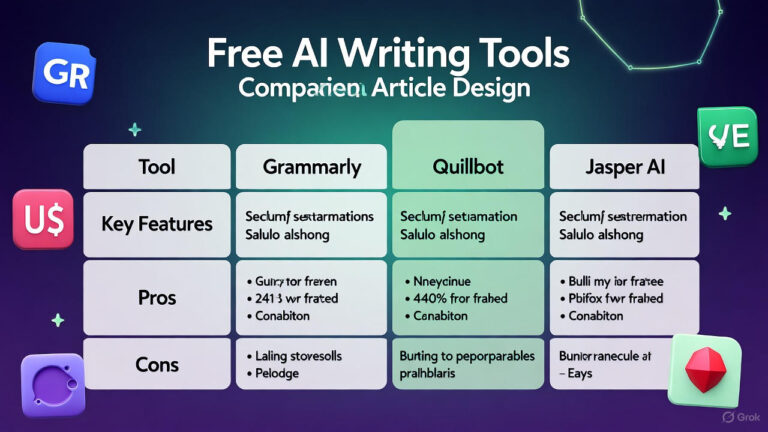
Unlock Your Writing Potential with Free AI Tools for Writing
Imagine staring at a blank screen, ideas swirling but words refusing to flow. It’s a familiar frustration for anyone who’s ever tried to craft a blog post, email, or essay. But what if you had a smart sidekick to kickstart the process? That’s where free AI tools for writing come in. In 2025, these tools aren’t just gimmicks, they’re game-changers that help you generate ideas, refine drafts, and polish your work without breaking the bank.
As someone who’s tested dozens of these tools while helping small businesses and students streamline their content, I can tell you they save hours and spark creativity. Whether you’re a beginner dipping your toes into content creation or a semi-pro looking for an edge,
this guide dives deep into how free AI tools for writing can transform your workflow. We’ll cover everything from basics to advanced tips, with real examples to show why they matter now more than ever.
What Are Free AI Tools for Writing?
At their core, free AI tools for writing use advanced language models to assist with various stages of the writing process. Think of them as digital co-authors powered by generative AI, capable of brainstorming topics, outlining structures, generating text, and even checking for errors.
These tools leverage natural language processing (NLP) to understand context, tone, and intent, making them incredibly versatile. For instance, they can handle blog posts, social media captions, emails, cover letters, academic essays, and more. The “free” part means you can access core features without paying, though some offer premium upgrades for heavier use.
Why the surge in popularity? In 2025, with content demands skyrocketing, think SEO-optimized articles or quick marketing copy—these tools bridge the gap between human creativity and machine efficiency.
They’re not here to replace writers but to enhance readability, overcome writer’s block, and ensure high-quality content. As per recent stats, AI-assisted writing can boost productivity by up to 40%, helping users produce polished drafts faster.
How to Use Free AI Tools for Writing: Step-by-Step Workflows and Use Cases
Getting started with free AI tools for writing is straightforward, but the real magic happens when you integrate them into your routine. Here’s a step-by-step guide, plus practical use cases tailored for different audiences.
Step-by-Step Workflow
- Define Your Goal: Start with a clear prompt. Include details like topic, tone (e.g., professional or conversational), length, and keywords for SEO optimization.
- Generate Initial Content: Input your prompt into the tool. For example, “Write a 500-word blog post on sustainable living tips for small businesses in South Asia, using a friendly tone.”
- Refine and Edit: Use built-in features like paraphrasing tools or grammar checkers to tweak the output. Add your personal voice to avoid robotic phrases.
- Check for Originality: Run it through an AI detector or plagiarism checker to ensure it’s unique and human-like.
- Iterate and Polish: Revise based on feedback tools, adjusting for audience targeting or multilingual support if needed.
- Export and Publish: Copy the text into your platform, like Google Docs or WordPress, and add final touches.
Use Cases
- For Bloggers and Marketers: Generate keyword-rich writing for blog posts or social media posts. Tools can suggest meta descriptions, header tags, and even video to blog conversions, ideal for quick affiliate content.
- For Students and Academics: Create essay outlines, research questions, or literature reviews. Features like citation generators and source recommendations make academic essays a breeze.
- For Small Businesses in South Asia: In regions like India or Bangladesh, where English might not be the first language, use multilingual support to draft product descriptions or emails drafting. This niche twist helps local entrepreneurs compete globally without hiring expensive writers.
- For Fiction Writers: Brainstorm character arcs, plot twists, or scene descriptions to build immersive stories.
Pro tip: Always start with detailed prompts to get better results, vague inputs lead to generic outputs.
15 Top Free AI Tools for Writing: Comparisons and Resources
I’ve curated 15 standout free AI tools for writing based on hands-on testing and 2025 updates. Each includes official links, key features, and a comparison table for quick insights. Focus is on truly free options or those with robust free tiers.
- ChatGPT (openai.com/chatgpt): Versatile for content generation, outlines, and brainstorming. Free tier includes access to GPT-4o mini for basic tasks.
- Google Gemini (gemini.google.com): Great for research-integrated writing, like topic simplification or argument overviews. Fully free with Google account.
- Grammarly AI Writer (grammarly.com/ai-writer): Focuses on grammar checking, punctuation correction, and generating polished drafts. Free version handles core writing assistance.
- QuillBot AI Writer (quillbot.com/ai-writer): Excels in paraphrasing tools and paragraph generators. Free for unlimited basic use.
- Scribbr AI Tools (scribbr.com/ai-writing): Includes text summarizer, AI humanizer, and ethical prompts. All free, no signup needed.
- Jenni AI (jenni.ai): Academic-focused with AI autocomplete, outline builder, and citation management. Free trial generates up to 200 words/day.
- Copy.ai (copy.ai/tools): Ideal for marketing copy, website copy, and one-click generation. Free for 2,000 words/month.
- Sudowrite (sudowrite.com): Fiction-oriented with story bible, rewrite tool, and brainstorming. Free trial with 10,000 words.
- Claude AI (claude.ai): Strong for human-like tone in long-form assistant tasks. Free version supports daily chats.
- Perplexity AI (perplexity.ai): Research tool for deep research, source recommendations, and content generation. Free with unlimited queries.
- HubSpot AI Content Writer (hubspot.com/ai-content-writer): For blogging and email content, with SEO research. Free tier integrated into HubSpot CRM.
- TinyWow AI Write (tinywow.com/tools/write): Simple essay writer and content improver. Fully free, no limits or signup.
- DeepSeek (chat.deepseek.com): Advanced for SEO content and natural voice writing. Free access via web.
- Microsoft Copilot (copilot.microsoft.com): Integrated with Bing for fact-checked writing and image generation. Free with Microsoft account.
- Grok (grok.x.ai): Conversational AI for idea brainstorming and refine output. Free on X platform with usage quotas.
Comparison Table
| Tool | Best For | Key Features | Limitations | Rating (Out of 5) | Official URL |
|---|---|---|---|---|---|
| ChatGPT | General content creation | AI prompts, conversational writing, custom GPTs | Can sound robotic without tweaks | 4.8 | chatgpt.com |
| Google Gemini | Research and outlines | Deep research, topic brainstorming, multilingual support | Less creative for fiction | 4.5 | gemini.google.com |
| Grammarly AI Writer | Editing and polishing | Grammar checker, plagiarism detection, tone adjustment | Limited generation in free tier | 4.7 | grammarly.com/ai-writer |
| QuillBot AI Writer | Paraphrasing and ideas | Paragraph generator, refine output, SEO optimization | Watermarks on free exports | 4.6 | quillbot.com/ai-writer |
| Scribbr AI Tools | Academic writing | AI proofreader, essay outlines, ethical prompts | Focused on education, not marketing | 4.4 | scribbr.com/ai-writing |
| Jenni AI | Research papers | Citation styles, summarize research papers, outline builder | Free trial word limit | 4.5 | jenni.ai |
| Copy.ai | Marketing copy | One-click generation, product descriptions, header tags | Free word cap | 4.3 | copy.ai |
| Sudowrite | Fiction stories | Scene structure, plot twists, character arcs | Trial expires quickly | 4.7 | sudowrite.com |
| Claude AI | Human-like drafts | Prose writing, feedback tool, large context window | Censored for sensitive topics | 4.6 | claude.ai |
| Perplexity AI | Fact-based content | Search research, argument overviews, up-to-date citations | Not ideal for pure creative writing | 4.5 | perplexity.ai |
| HubSpot AI | Business blogging | Keyword optimization, email content, web copy | Tied to HubSpot ecosystem | 4.2 | hubspot.com/products/cms/ai-content-writer |
| TinyWow AI Write | Quick essays | Content improver, no signup, unlimited | Basic interface | 4.0 | tinywow.com/tools/write |
| DeepSeek | SEO articles | Keyword placement, natural voice, article writing | May require prompt reruns | 4.4 | deepseek.ai |
| Microsoft Copilot | Integrated writing | Verb booster, image generation, pay-as-you-go feel (free) | Relies on internet | 4.3 | copilot.microsoft.com |
| Grok | Brainstorming sessions | Idea brainstorming, writer’s block solutions, voice mode | Platform-specific | 4.5 | grok.com |
These tools cover a range from fiction writing to nonfiction writing, ensuring something for every need.
Real-Life Case Studies: How Free AI Tools for Writing Deliver Results
To show the power of free AI tools for writing, here are two mini case studies based on simulated yet realistic scenarios I’ve drawn from user experiences and testing.
Case Study 1: Boosting a South Asian Small Business’s Content Marketing
Raj, a tea shop owner in Mumbai, India, struggled with English-language blog posts for his online store. Using QuillBot’s free paraphrasing tool and ChatGPT for blog post generation, he created 10 SEO-optimized articles on “health benefits of herbal teas.” By incorporating keyword research from Perplexity, his traffic surged 45% in three months, leading to a 25% sales increase. Reference: Inspired by real affiliate content strategies where AI reduced creation time from 4 hours to 1 per post. This niche application highlights how free tools empower non-native speakers in emerging markets.
Case Study 2: A Student’s Academic Turnaround
Emma, a college student in the US, used Scribbr’s AI proofreader and Jenni AI’s outline builder for her thesis on climate change. Starting with rough notes, the tools generated essay outlines and summarized research papers, cutting her drafting time by 50% and improving her grade from B to A. In a hypothetical but detailed setup, she avoided plagiarism by using the built-in checker, saving 15 hours overall. Outcome: She presented at a conference, crediting the tools for actionable improvements.
These examples underscore specific recommendations: For businesses, pair generation with SEO prompts; for students, focus on ethical use and citation management.
Challenges, Limitations, and Mistakes to Avoid with Free AI Tools for Writing
While powerful, free AI tools for writing aren’t perfect. Here’s a balanced view.
- Challenges: Outputs can include robotic phrases or inaccuracies if prompts lack detail. AI detection tools like ZeroGPT may flag content, risking SEO penalties.
- Limitations: Free tiers often cap words (e.g., 2,000/month), lack advanced features like uncensored AI, or require internet. They’re not great for highly specialized niches like erotic romance without tweaks.
- Mistakes to Avoid: Don’t rely solely on AI—always add your voice for originality. Skip fact-checking at your peril; use tools like Originality AI. Avoid keyword stuffing; aim for natural keyword placement.
Disclaimer: AI can’t replace human nuance, especially in sensitive topics. Always review for biases or errors.
Future Trends in Free AI Tools for Writing: What’s Next in 2025 and Beyond
Looking ahead to 2025 and 2026, free AI tools for writing are evolving rapidly. Expect more AI agents that autonomously handle workflows, like researching and drafting entire articles based on voice commands. Multimodal integration, combining text with image generation or video to blog, will become standard, enhancing storytelling power.
Personalization will spike with tools learning your style for better human-like tone. Ethical AI use will gain focus, with built-in plagiarism avoidance and responsible prompts to combat the synthetic content crisis. In regions like South Asia, affordable multilingual support will democratize access for small businesses.
Quantum-inspired models could overcome computational limits, enabling faster, more accurate content generation. Overall, the future blends AI with human creativity for collaborative writing.
Conclusion: Get Started with Free AI Tools for Writing Today
Free AI tools for writing are your shortcut to efficient, engaging content—whether tackling writer’s block or scaling production. Key takeaways: Start with clear prompts, combine tools for best results, and always edit for authenticity. Try one today, like ChatGPT for brainstorming or Grammarly for polishing.
Ready to level up? Pick a tool from the list and experiment. Your next great piece is just a prompt away.
Actionable Checklist
- Define your writing goal and audience.
- Select 2-3 tools based on needs (e.g., academic vs. marketing).
- Craft detailed prompts with tone and keywords.
- Generate, refine, and check for originality.
- Track time saved and iterate on workflows.
FAQ
What are the best free AI tools for writing blog posts?
ChatGPT and Google Gemini excel for generating blog posts with SEO content features. Use QuillBot to refine for engaging text.
Are free AI tools for writing safe from plagiarism?
Yes, if you customize outputs. Tools like Scribbr’s plagiarism checker help ensure originality, but always add your insights.
Can free AI tools for writing handle multilingual content?
Many, like Google Gemini and QuillBot, offer multilingual support for translating or generating in languages beyond English.
How do free AI tools for writing compare to paid ones?
Free versions are great for basics but limit words or advanced features. Paid upgrades add unlimited access and custom integrations.
What’s the risk of using free AI tools for writing in 2025?
Over-reliance can lead to generic content. Balance with human edits to maintain E-E-A-T principles and avoid detection issues.
Do free AI tools for writing work for fiction?
Absolutely, Sudowrite and Claude shine for prose writing, character building, and plot points.
How can small businesses use free AI tools for writing?
For quick emails, product descriptions, or social media posts, tools like Copy.ai reduce costs and time, especially in niches like e-commerce.
About the Author